
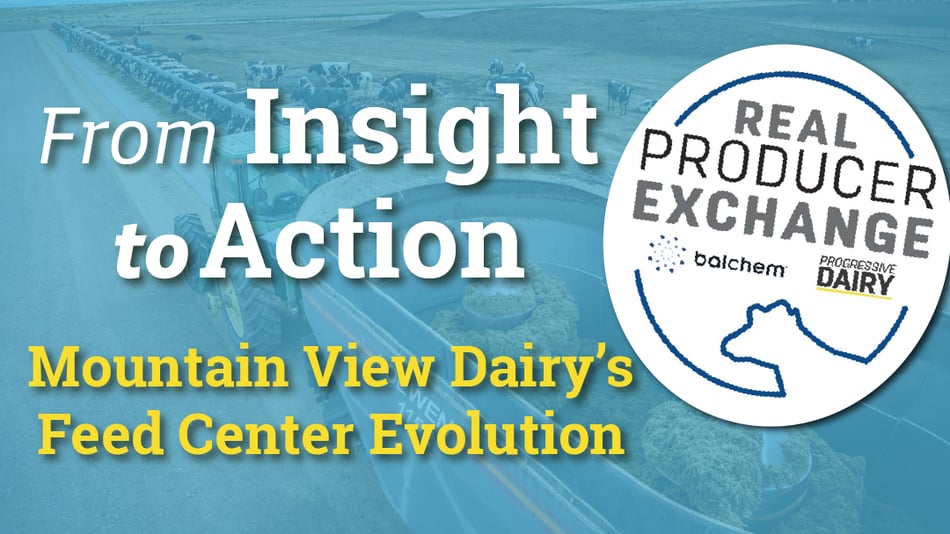
The Real Producer Exchange series from Progressive Dairy offers something rare in today’s industry conversations: an honest look at the decisions producers make every day — the successes, the challenges, and the lessons learned along the way. Instead of focusing only on best-case scenarios, each episode invites dairy leaders to openly share what worked, what didn’t, and what they would do differently.
Amelicor chose to sponsor this particular episode because the featured producer, Greg Nye of Mountain View Dairy, exemplifies the kind of practical innovation shaping modern dairy operations. Our team has supported Greg and his nutritionist, Jed Southwick, through the development of Mountain View’s feed center using EZfeed and EZweights to refine ration accuracy, mixing consistency, and ingredient handling.
The depth of that collaboration came through in the live Q&A session that followed the broadcast, where our representative, Brian Sleight, joined Greg and Jed to explain how EZfeed improves ration delivery by tightening loading accuracy, stabilizing mixing times, and maintaining consistency across operators. It’s one of the advantages of participating in Real Producer Exchange episodes in real time.
For us, this episode wasn’t just a sponsorship opportunity — it was a chance to highlight real on-farm decision-making from a producer applying both management discipline and data-driven workflows to move his operation forward. It’s the kind of story we believe deserves to be shared.
About the Featured Producer: Greg Nye & Mountain View Dairy
Greg Nye oversees Mountain View Dairy in Delta, Utah — an operation milking about 4,750 cows and feeding nearly 10,000 animals across three locations. As Operations Manager, Greg leads both the mechanical and feeding sides of the business, applying a practical, engineering-minded approach to daily decision-making.
In 2022, he completed a 57,000-square-foot enclosed feed center, a project designed to reduce shrink, improve ration consistency, and streamline ingredient handling. Built from years of planning and on-farm evaluation, the facility now delivers measurable improvements, including:
- Shrink reduction from 7.5–8% down to 2%
- Fuel savings of roughly $35,000 per month by eliminating mobile mixer
- Greater ration consistency across delivery distances ranging from 100 yards to 3.5 miles
- Simpler workflows with fewer ingredient touches and cleaner traffic flow
Greg describes his approach as iterative rather than idealistic — “R&D: rob and duplicate” — adapting proven ideas from other industries and refining them to fit the scale and geography of his dairy. His leadership also reflects the dynamics of a multigenerational operation, where trust and shared responsibility guide daily decisions.
As he put it during the live Q&A session, one of the principles that drives their progress is simple:
“You always have to dream. You always have to look ahead. If you're standing still or living in yesterday, quite honestly, I think you're falling behind.”
Key Takeaways From the Episode
1. Shrink Reduction Is One of the Fastest Paths to ROI
Before building the enclosed feed center, Mountain View Dairy experienced 7.5–8% shrink, driven by wind, weather, and repeated handling. After transitioning into the new facility, shrink dropped to a consistent 2%, delivering major financial returns almost immediately..
Greg noted that at current ingredient prices, the feed center is on track for a four-and-a-half-year ROI, with shrink reduction being the most significant contributor. When feed is your largest expense, even small percentage improvements translate into substantial annual savings.
2. Ration Consistency Improves When Process Variability Is Removed
One of Greg’s primary goals was to eliminate inconsistencies caused by variable mixing times, operator differences, and long travel distances. With stationary mixers and automated batching through EZfeed, Mountain View Dairy achieves a level of consistency that was not possible with mobile mixers spread across multiple sites.
As Greg explained, consistent batching now allows cows to receive the same ration every day, regardless of who is feeding or how far the load needs to travel.
3. Efficiency Comes From Designing Around Real-World Weak Points
Rather than starting with an ideal design, Greg began by identifying the biggest operational bottlenecks:
- Too many ingredient touches
- Equipment congestion
- Traffic overlap between delivery and feeding
- Inefficient placement of high-use ingredients
- Time lost waiting for trucks to unload
He built the new feed center to eliminate these issues directly — separating traffic, centralizing raw ingredients, staging loads ahead of delivery, and simplifying mixer operation into a straightforward, three-button workflow. This problem-first design approach reduced labor bottlenecks, lowered fuel costs, and improved feeding throughput.
4. Safety Improves When Traffic and Tasks Are Separated
Greg emphasized the importance of reducing risk by separating feeding traffic from delivery traffic. In the old layout, trucks and loaders frequently crossed paths, creating inefficiencies and safety concerns. The new design eliminates crossover and routes all unloading to exterior access points, reducing downtime and creating a safer environment for employees.
5. Multi-Generational Success Requires Trust and Shared Responsibility
Greg spoke candidly about managing a multigenerational dairy operation. His parents’ willingness to offer guidance without overruling decisions — and to allow room for learning — has helped him step confidently into leadership. Cross-training employees has also strengthened the operation by improving decision-making, reducing bottlenecks, and enabling team members to cover for each other when needed.
6. Innovation Doesn’t Require Reinventing the Wheel
Greg was humorous but honest about his mindset:
“R&D = rob and duplicate.”
He studies industrial plants, batch systems, other dairies, and online resources, adapting proven ideas to fit his scale and geography. By remaining flexible and willing to revise, he developed a feed center that meets the needs of their multi-site operation without over-engineering the solution.
7. Customer-Led Adaptation Makes Technology More Valuable
The episode showed how Mountain View Dairy integrates EZfeed and EZweights into daily workflows:
- EZweights tracks all commodity deliveries and scale data.
- EZfeed manages batch accuracy, ingredient handling, mixing times, and sequencing.
- Together, they tie inventory, batching, and delivery into one coordinated system.
As reinforced in the live Q&A, Greg is not adapting his operation to fit the software — the software adapts to him. His on-farm feedback continues to drive improvements within EZfeed and EZweights, strengthening their value for other producers.
Amelicor’s Role in the Episode
As the sponsor of this Real Producer Exchange episode, Amelicor had the opportunity to share a short opening video highlighting our commitment to practical, on-farm data tools.
The episode itself showed the strength of the partnership behind Mountain View Dairy’s feed center project, with Greg describing how EZfeed and EZweights support the daily workflows inside his operation. That partnership was reinforced even further during the live-only Q&A, where our representative Brian Sleight and nutritionist Jed Southwick joined Greg to answer producer questions and discuss how the tools help refine batching accuracy, mixing consistency, and ingredient handling. Together, their comments highlighted the value of pairing producer insight with adaptable software to improve day-to-day decision-making.
Exclusive Q&A Highlights
The main episode is available on YouTube, but the extended Q&A that followed was exclusive to those who attended the webinar live. This live-only segment added an extra layer of value as Greg, his nutritionist Jed Southwick, and Amelicor’s Brian Sleight answered questions directly from producers. Below are several notes and key takeaways from that discussion — insights that offered an unfiltered look at how they approach ration consistency, ingredient handling, facility design, and the role of technology in a multi-site feeding operation.
1. “There are three rations on a dairy.” — Greg Nye
Greg opened the Q&A by highlighting a familiar industry truth:
“There are three rations on a dairy — the one the nutritionist designs, the one that gets loaded, and the one that actually gets delivered.”
He noted that inconsistencies arise from processing time, travel distances, and operator variability. With the feed center and EZfeed working together on the front end of batching and loading, the dairy now sees far fewer discrepancies between the ration on paper and the ration that reaches the cows — leading to noticeably better consistency across all three facilities.
2. “We definitely saw a response… in production and components.” — Jed Southwick
Jed shared that once the delivery system was refined and rations were being mixed and delivered consistently with help from EZfeed, the herd responded quickly:
“We definitely saw a response not only in milk production but also in components.”
He explained that a consistent TMR — neither over-mixed nor under-mixed — improved cow performance and cow health. While shrink reduction delivers clear economic benefits, Jed emphasized that the performance gains likely drive ROI even faster.
3. “It doesn’t fluctuate when a relief feeder comes in.” — Brian Sleight
Brian explained how EZfeed helps stabilize batching and mixing regardless of who is on shift:
“With a stationary mixer, you're able to get consistency day in, day out… It doesn’t fluctuate when a relief feeder comes in or someone needs to leave early.”
Because EZfeed manages batching logic, pauses, timing, and order of operations, it helps eliminate operator-driven variability — making ration accuracy more reliable even when staffing changes.
4. “EZfeed is set up for small-ingredient handling.” — Brian Sleight
A question about micro ingredients led Brian to explain how EZfeed manages small-inclusion feeds without requiring a dedicated micro machine:
“EZfeed is set up for small-ingredient handling. It can tell the feeder exactly what small amount to add — like 33 pounds of bicarb — and pause the batch so they can weigh it out accurately before moving on.”
He clarified that EZfeed includes a built-in small ingredient function, allowing managers to insert a pause and detailed instruction directly into the batch. When the feeder reaches that step, EZfeed prompts them to weigh out the specified amount on a small scale and add it to the mixer. Because these quantities are often too small to noticeably change the scale weight, EZfeed does not generate errors or warnings — instead, once the ingredient is added, the feeder simply advances to the next step and continues loading larger ingredients normally.
This gives dairies the accuracy of micro additions without the cost of specialized hardware.
Watch the Full Episode
The full recording of Real Producer Exchange: Mountain View Dairy with Greg Nye is now available for anyone who wants to explore the discussion in depth. The episode walks through every stage of Greg’s project — from the early design sketches and ingredient-flow challenges to the final build-out of the 57,000-square-foot feed center.
It also includes insights into the operational decisions that influenced the design, such as:
- why certain ingredients were placed closer to the mixers
- how semi-based delivery helped overcome bottlenecks experienced with tractors
- he impact of consolidating ingredient handling into a single enclosed space
- what Mountain View Dairy learned while batching and delivering feed across three geographically separated dairies
Watch the episode here:
If you're evaluating a facility upgrade, exploring stationary mixers, or looking to better understand how operational design affects ration consistency and cow performance, this episode is well worth your time. Greg’s openness — including references to the work he and his nutritionist, Jed Southwick, have done to refine their feeding system — offers a practical look at how thoughtful design and daily decision-making translate into better results for both cows and people.
How Amelicor Supports Today’s Producers
Many of the challenges discussed in this episode — ration consistency, ingredient accuracy, operator variability, inventory control, and cross-facility coordination — are the same challenges our team at Amelicor helps producers navigate every day. Mountain View Dairy’s experience shows how thoughtful facility design and the right data tools can work together to deliver meaningful operational improvements.
Our feed and herd management products are built for the realities of today’s dairy production:
- EZfeed improves batching accuracy, mixing consistency, ingredient handling, and operator accountability — whether you’re feeding a single site or delivering across several miles.
- EZweights tracks every incoming commodity, supports inventory accuracy, and helps dairies monitor shrink and ingredient movement over time.
- DHI-Plus centralizes herd records and reporting, giving producers a dependable, local-first system that syncs automatically with the Amelicor Cloud whenever internet connectivity is available.
These tools are designed to adapt to each dairy’s workflow — not the other way around. The improvements Greg and his team have achieved at Mountain View Dairy illustrate what’s possible when consistent data, practical management, and flexible technology come together.
If you’d like to explore how these tools can support your farm’s goals or address challenges similar to those highlighted in this episode, we’d be happy to connect.
Lessons Worth Carrying Forward
We appreciate the opportunity to support Real Producer Exchange and to help bring conversations like this one to the wider dairy community. Episodes like these remind us that progress in our industry doesn’t come from theory alone — it comes from producers willing to share what they’ve learned, what they’ve improved, and what they would do differently the next time around.
A sincere thank-you to Greg Nye for offering such an open look at Mountain View Dairy’s feeding system and the decision-making behind their feed center project. Thanks as well to Jed Southwick, whose nutritional insights provide essential context to the operational changes on the farm, and to Walt Cooley and the Progressive Dairy team for creating a platform where these conversations can happen.
Most importantly, thank you to everyone who registered or attended. We’re grateful for your engagement and hope the insights shared in this episode support your own decision-making — whether you’re considering a facility upgrade, refining your feeding workflow, or simply looking for ideas to strengthen consistency and cow performance.
We look forward to supporting future episodes and continuing to help producers build operations that are efficient, resilient, and grounded in great daily decisions.